

Short Reflections from the First Few Weeks of Aura Check
If I had a co-founder, here’s what I’d tell them. Since I don’t, I’m sharing some short reflections publicly.

So, I launched the Aura Check SMS service a few weeks ago. Since then, very kind people have been giving me feedback. One man (who shall not be named) even admitted to using it to crash out over his company shutting down, which gives me slight pause that I may be building a men’s therapy app. That’s not the worst thing in the world, but I’m also not sure I have it in me to heal the patriarchy.
New Focus: Digital Tools for Nervous System Regulation (aka Crashing Out)
When I launched, the product itself was very simple. You, yes you, could clone this repo and spin it up in under an hour. But the focus wasn’t simple. I was doing “aura-esque” readings, astrology, crash-out resets, you name it. The scope creep was real and confusing.
So I’m picking a lane and staying in it (for now, famous last words). Aura Check is now dedicated to the crash-out moment, aka nervous system regulation. That’s the core of the vision and the most interesting intersection between AI and embodiment. Not therapy, not a friend, but a kind of mind-body reset. I reworked the product and voice to only focus on this aspect.
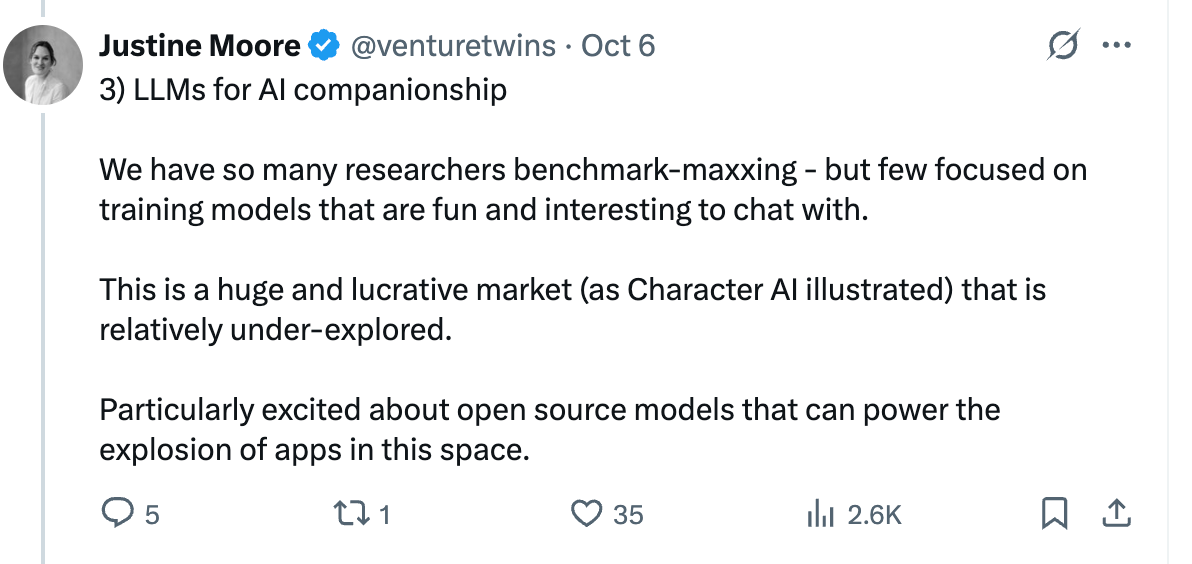
This also sets the stage for what’s next: layering in context like biometrics and emotional state, and riding the infrastructure wave as conversational LLMs get better. As Justine Moore recently wrote in her “call for startups,” there’s still a big gap between benchmark-maxing and models that are actually fun and interesting to talk to.
Distribution is Hard
Ok, I get it. It’s really hard. I have three TikTok ghost accounts (and soon many more) running and have managed to partially automate the creation of ~100+ videos a month using AI. I think I’m close to going viral on two, but basically the thinking goes: if you integrate a call-to-action and one video hits 1M views, even a small percentage conversion could bring in thousands of texts/sign-ups. This is a pretty well-known growth hack at this point.
Still, this kind of growth hacking doesn’t align with my vision. It feels a little schemey. Not bad, and maybe useful at first for initial metrics, but also does not feel sustainable.
A Way Forward: The Community Layer
I’ve been thinking a lot about Chris’ article on community-led distribution. His point is that sustainable distribution doesn’t come from paid ads or algorithms, but from belonging. The strongest products start with a clear “identity wedge,” co-create with their community, and anchor growth to real-world rituals. Community not only becomes the distribution engine, but also the brand and in many cases the product itself.
Community has always been central to scaling tech (think Figma’s launch on design Twitter), but what feels different now is that in a world of commoditized software, community is becoming the moat. It drives defensibility and retention, and maybe even opens the door for more bootstrapped founders (think Arena-esque “software lifestyle businesses”).
In AI and software circles, there’s an appetite to align with brands that put community at the center. The Anthropic pop-up proved it. People raved about the design and the merch (I’ll admit I didn’t fully get that part), but what really stood out was the community it surfaced and the latent demand it signaled. Tech folks were flying across the country for a “thinking” hat. That wasn’t about merch; it was about belonging to a new ethos of tech. It felt like a deeply personal reaction for people who are techno-optimist but also want AI positively integrated into society, instead of the doom-scroll “AI will take your job” narrative. It was a rally around a more hopeful vision.
Aura Check’s own community lives inside an identity wedge too: the emerging somatic wellness world (overlapping circles of sauna, breathwork, yoga and pilates crowds). The opportunity now is to make them not just users, but architects.
That’s what I would be telling a co-founder if I had one. Instead I’m saying it here. If you’re still with me, thanks for reading what is basically a note to myself.